
Have you ever wondered where hiccups come from? Believe it or not, it’s the diaphragm going through a muscle spasm. All muscles have “holding patterns” in regard to tension, and I think as a society that holds stress in our body, now is a good time to attempt to normalize spasm and even disfunction of muscles because it is not the end of the world, even if it can sometimes feel like it. Unlike spinal/structural disfunction, muscular function can be improved with or without the help of a practitioner. I often say to my clients; “This was a very effective session, however this was only one day out of your week. What are you doing the other six?”
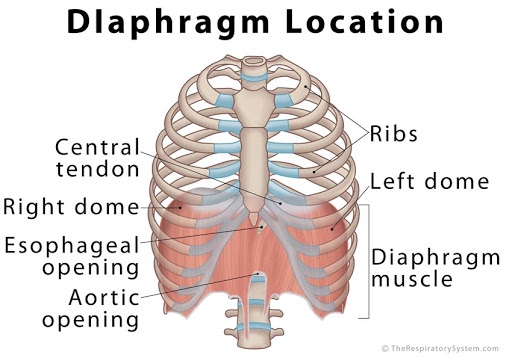
In a world that was already filled with anxious people, we are now grappling with a pandemic. I think now is a time for blunt solutions, and to speak clearly about the anatomy of Covid 19 from a muscular perspective. There is a lot we don’t know, but one thing we can continue to refine is the way we breathe. When breathing, the primary area of expansion is the ribcage, both at the lungs, and the diaphragm. The diaphragm is a muscle that attaches at the tip of the sternum, and runs to the bottom of the ribcage. While breathing normally in an upright, standing position it can sometimes be difficult to see the intervention of the diaphragm. This is because the chest is the primary area of movement, and due to the diaphragms location beneath the ribs. To get the diaphragm working more efficiently we have to train it. Think of it like a balloon filling with air. When we inhale the balloon fills with air and vice versa with exhalation. It is much easier to see and feel the diaphragms intervention while lying on your back face up, as is why activities like yoga and pilates tend to be breathing based, therefore stress reducing. Start by placing your hands over the space between your stomach and ribcage that rises up when you take a breath. It might feel uncomfortable to breathe from here, but don’t be discouraged. Everyone has a different amount of restriction and discomfort here, and the purpose of the regiment I’m about to explain can be done by anyone, it just takes practice to change the method in which you are breathing. In order to open the diaphragm we first must move past whatever is restricting it, so before beginning it may help to ground and set an intention for the self care you are about to embark on.
Whether its deadly pandemic, or anxiety that is a derivative, diaphragmatic breathing is step one to having more control of the mind, and of respiratory function. The body and the mind work together as one unit, so step one is becoming conscious as to what you are feeling at the diaphragm, and step two is deciding what you’d like done about it. in the event that you, or someone you know falls ill, this regiment could serve as a tool for improving the ability to breath in a natural way.
HOW TO TRAIN DIAPHRAGM:
- Lie face up on a comfortable surface and place one hand on the diaphragm, and the other on your chest. Take 5 deep breaths, and test your ability to use the diaphragm in breathing. (Your chest will rise first and what we want to see is the hand lying over the stomach also rise) Don’t be discouraged if the stomach hand doesn’t rise very much at first as this is the purpose of testing.
- The diaphragm is a muscle, so we must strengthen it in order to have better function. Find 3 books: One novel you’ve been saying you were going to read in quarantine but haven’t, a textbook, and if possible a heavier book like an encyclopedia. Imagine again the diaphragm as a balloon that fills with air on the inhale, and deflates on the exhale. Place the textbook on your stomach over the diaphragm location closer to the ribs and take 5 more deep breaths. Seeing the book move can be a better indicator of how you are restricted. Set your intention on getting the book to rise higher with each breath. Keep your spine glued to the floor as we don’t want to cheat and arch the back.
- This step focuses on opening the diaphragm and strengthening its function on the inhale. Using the textbook, take a deep breath into the stomach (its okay for the chest to rise as well, just continue focusing on the use of the diaphragm for this activity.) Breathe in through the nose for a 5 second count, hold that breath for a 2 second count watching the book rise, and release this breath with force exhaling slowly for 10 seconds through the mouth until all the breath is released. On the exhale the diaphragm is relaxing so when holding your breath take a moment to consciously relax the rest of your body. Start by imagining your head, neck, and spine being very heavy and relaxed into the floor, and so forth with the rest of the body until you feel as limp as possible before forcefully letting the breath go.
- The diaphragm contracts, or is in use when we inhale. If one were to envision the purpose of each breath, the inhale would be for strengthening, and functional improvement, and the exhale about release, relaxation, rewarding the body for good work. In regard to release it often helps to hum, or make noise on the exhale. (There is a lot of shaming in our society about making noises deemed “weird”, but that is absolutely backwards. Perhaps take this time when you are in your house away from people to confront what needs to be released. A lot of shame, anger, stress, and sadness as well as positive emotions can be released through noise making. We only seem to make noise when we are in periods of joy however which can change through this activity.)
- After taking yourself through this breathing regiment, and you feel you’ve mastered the basics, you can now move on to repetition. If your diaphragm is still having difficulty with movement try the encyclopedia, or two textbooks. What we are trying to achieve here is better endurance of the diaphragm, and this can only happen through practice, and altering the weight to what feels comfortable to you. Take yourself through 10 repetitions of the breathing regiment remembering to relax your body on the exhale and to move the books on the inhale. Do 2 sets of 10 repetitions taking a 15 second break in between each set. This isn’t the type of exercise to rush, so take your time and listen to what your body is telling you.
- The purpose of the unmentioned novel is for practice when you aren’t training. This book should be low weight and only showcase your ability when sedentary to breath with the diaphragm. The novel serves as a measuring tool when you aren’t performing this regiment to measure how much better your diaphragm is functioning. Trust me when I say you will likely see immediate improvement.
The diaphragm is a place that we commonly hold stress, particularly emotional. In my practice, Ive spent entire sessions working with clients on breath training when we’d had other plans upon them walking in. Often, the diaphragm functioning incorrectly is the tip of the iceberg when letting go of trauma, and correcting other issues that may at first glance seem unrelated. For instance, I find that the diaphragm’s compression effects digestion, and contributes to severe menstrual symptoms because of how this compression can effect posture. Whether its stress, anxiety and depression, or the unfortunate events from a worldwide pandemic, the keys to breathing control begins within you.

 reefRX